
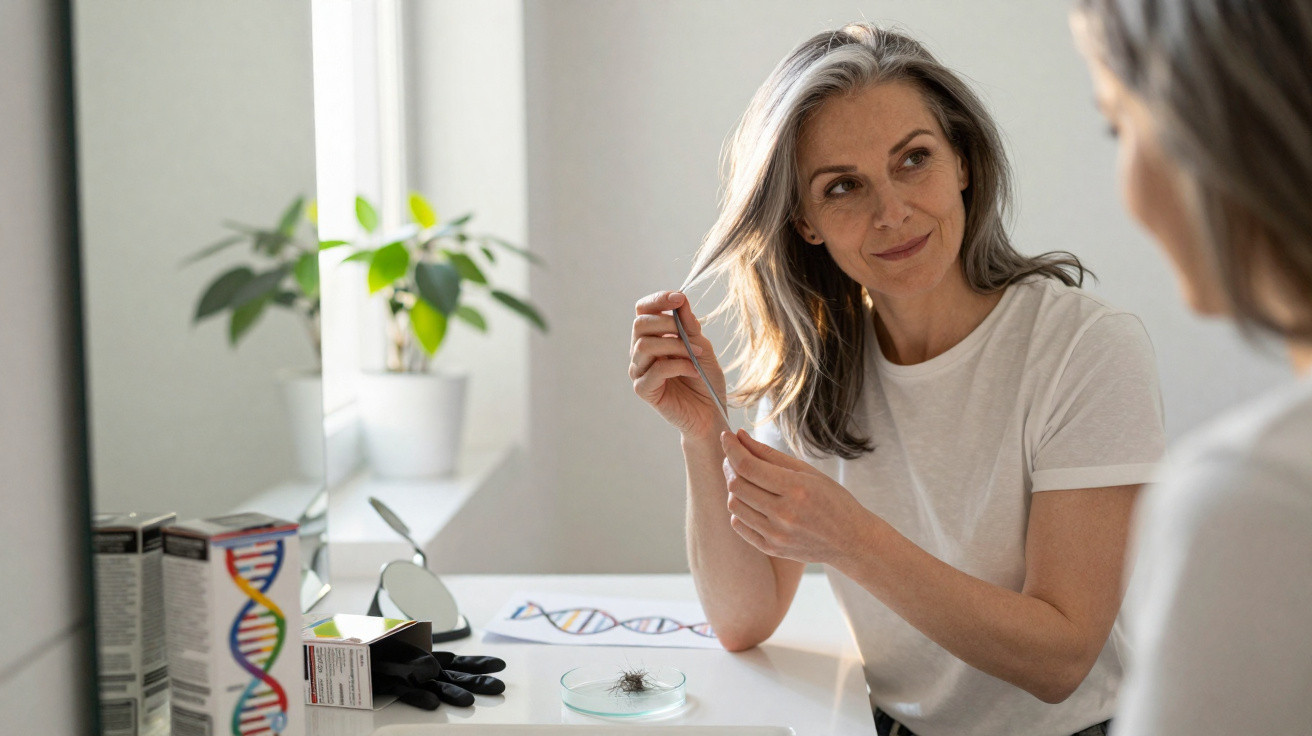
How soon we begin to go grey is largely written in our genes.
For most people, the first grey hairs show up at some point from their 20s through to their 50s. In men, greying commonly begins at the temples and sideburns. Women are more likely to notice it first along the hairline, particularly at the front.
The quickest period of greying is typically between the ages of 50 and 60. But can everyday habits accelerate it? And are there ways to slow it?
You may have heard claims that plucking, dyeing and stress can turn hair grey - and that people with red hair do not go grey at all. Here is what research indicates.
What gives hair its colour?
Every hair fibre is formed inside a hair follicle, a small tunnel-like opening in the skin. Within the follicle are two types of stem cells:
- Keratinocytes, which make keratin - the protein that forms hair fibres and helps regenerate them
- Melanocytes, which create melanin - the pigment responsible for colouring hair and skin
Hair colour is mainly determined by two forms of melanin. Eumelanin is a dark brown-to-black pigment, while pheomelanin is a red-to-yellow pigment.
The balance of these pigments produces different shades. Black and brown hair contains mostly eumelanin; red hair contains the greatest amount of pheomelanin; and blonde hair contains only small amounts of both.
So what makes our hair turn grey?
As we get older, it is normal for cells to become less active. In hair follicles, this reduced activity means stem cells make less melanin - so hair looks grey - and less keratin, which contributes to thinning and hair loss.
When melanin production drops, there is less pigment available to colour the hair. Grey hair contains very little melanin, and white hair has none remaining.
Hair that lacks pigment can appear grey, white or silver because light bounces off keratin, which is a pale yellow.
Compared with pigmented hair, grey hair tends to be thicker, rougher and more rigid. This is linked to age-related changes in stem cells that make the follicle shape less regular.
Notably, grey hair also grows more quickly than pigmented hair, although doing so requires more energy.
Can stress turn our hair grey?
Yes - stress can contribute to hair turning grey. The mechanism involves oxidative stress damaging hair follicles and stem cells, which can halt melanin production.
Oxidative stress happens when there are too many harmful free-radical chemicals and not enough protective antioxidant chemicals in the body. Psychological and emotional stress can trigger this, as can autoimmune diseases.
Other influences may include environmental exposures such as UV radiation and pollution, along with smoking and some medications.
Melanocytes are more vulnerable than keratinocytes because producing melanin involves more complex steps. This helps explain why greying linked to ageing or stress often appears before noticeable hair loss.
Researchers have connected paler segments along individual hair fibres with stressful events in someone’s life. In younger people - whose stem cells were still able to produce melanin - hair colour returned after the stressful period ended.
Four commonly repeated beliefs about grey hair - and what science says about them:
1. Does plucking a grey hair make more grow back in its place?
No. If you pull out a hair, you may see a small bulb on the end that had been attached within the scalp - this is the root, which forms inside the follicle.
Plucking removes the root from the follicle, but the follicle itself is a structure in the skin and cannot be pulled out. Each follicle produces only one hair.
However, repeated plucking might lead to earlier greying if it damages or exhausts the cells that generate melanin through repeated regrowth.
2. Can my hair can turn grey overnight?
A story claims Marie Antoinette’s hair became completely white the night before the French queen was sent to the guillotine - but it is not true.
Melanin in the hair shaft is chemically stable, so it cannot change instantly.
In mice, severe psychological stress can quickly deplete melanocyte stem cells. Even then, the change is not seen at once: greying becomes noticeable only as hair grows, at around 1 cm per month.
And because not all hairs are in the growth phase at the same time, they cannot all turn grey simultaneously.
3. Will dyeing make my hair go grey faster?
It depends on the type of dye.
Temporary and semi-permanent dyes are unlikely to cause early greying because they sit on the surface of the hair fibre rather than altering its structure. Permanent dyes, by contrast, rely on a chemical reaction within the hair, typically using an oxidising agent such as hydrogen peroxide.
A build-up of hydrogen peroxide and other dye-related chemicals in the hair follicle can harm melanocytes and keratinocytes, which may contribute to greying and hair loss.
4. Is it true redheads don't go grey?
People with red hair also lose melanin with age, but the process differs from what happens in black or brown hair.
This difference relates to the chemistry of the red-yellow pigment compared with the black-brown pigment.
Making the brown-black pigment eumelanin is more complex and energy-intensive, which leaves it more prone to damage.
Producing the red-yellow pigment (pheomelanin) is simpler and generates less oxidative stress. As a result, stem cells can more readily keep producing pheomelanin even as their activity decreases with ageing.
Over time, red hair more often fades to strawberry blonde and silvery-white. A grey appearance reflects reduced eumelanin activity, which is why it is more often seen in people with black and brown hair.
Genetics largely sets the timing of when you will go grey. Still, you may be able to reduce the risk of premature greying by maintaining good health, managing stress, and avoiding smoking, excessive alcohol and too much UV exposure.
A nutritious diet may also be beneficial, because vitamin B12, copper, iron, calcium and zinc all affect melanin production and hair pigmentation.
Theresa Larkin, Associate Professor of Medical Sciences, University of Wollongong
This article is republished from The Conversation under a Creative Commons licence. Read the original article.






Comments
No comments yet. Be the first to comment!
Leave a Comment