
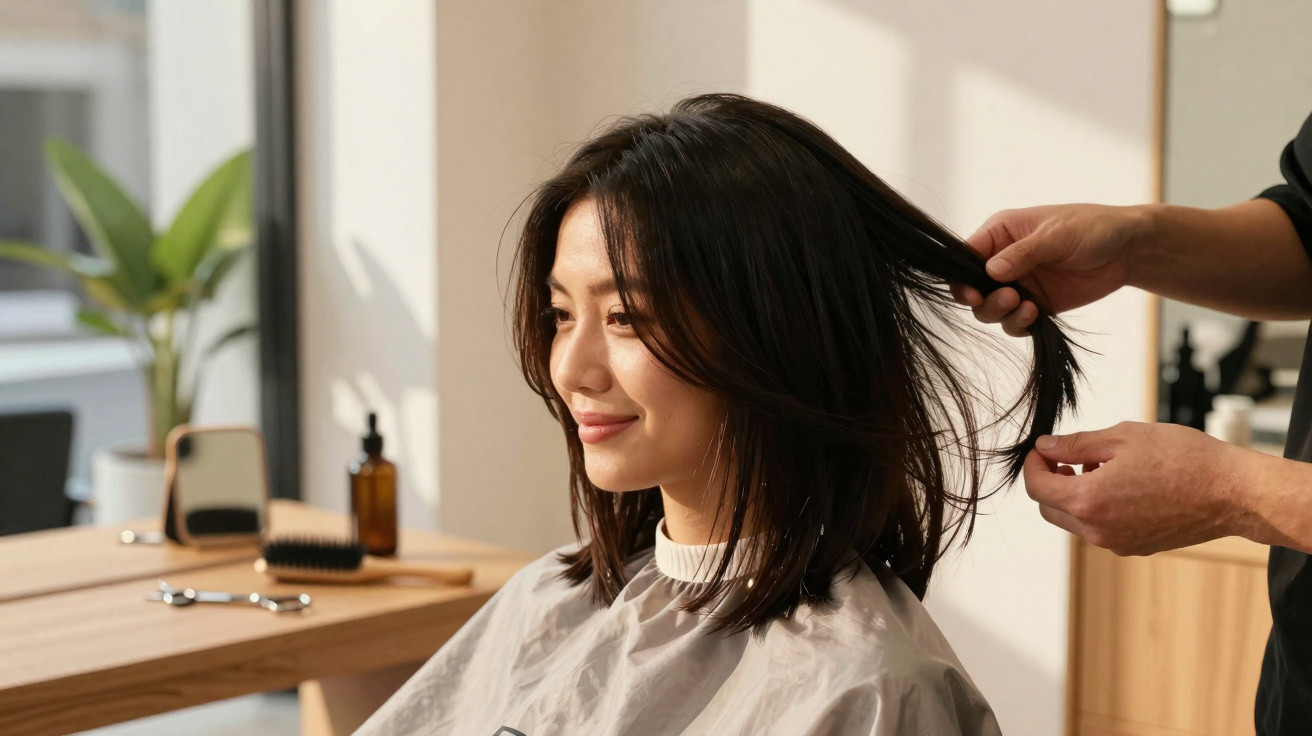
The woman in the mirror lets out a sigh. Her hair sits on her shoulders like a dark cape - glossy, thick, heavy; pure Instagram fantasy, and a post‑commute nightmare after eight hours at a desk. She tries to pin it up and, again, two hair bobbles snap. The bun slides. Sweat gathers at the nape of her neck. “Why does it look effortless on other people with this much hair, but on me it’s like I’m wearing a permanent wig?” she mutters, irritated, tucking a strand behind her ear.
Most of us recognise that moment when you feel your reflection more than you actually see it. When having a lot of hair stops feeling like a treat and starts feeling like a burden. When every salon appointment ends with the same question: “Shorter? Thinned out? Layers? Anything?”
And sooner or later, that’s often when people stumble across the one haircut that suddenly changes everything.
Why thick hair often looks heavier than it needs to
Thick, weighty hair sounds like a compliment, but day to day it can feel like you’re carrying it. The bulk pulls downward, the lengths hang, the roots sit flat, and your whole face can look as though it’s being dragged south. You can appear tired even when you’ve slept well.
What hardly anyone says out loud: the issue usually isn’t how much hair you have - it’s the way it’s been cut. A dense, compact shape - the classic “block” - makes every centimetre look and feel more substantial. There’s no movement, no air, no lift. Many women know this: they leave the salon with a “full, blunt cut” and then wonder why they suddenly look ten years older.
The reality is that thick hair needs space. Not a stubborn chop, but an architecture that shifts the weight to where it flatters your face.
A 34‑year‑old teacher from Cologne once described a scene that’s easy to picture. For years she’d had hip‑length, extremely thick hair. Everyone admired it; she herself wore it almost exclusively in a heavy knot. “I had headaches all the time,” she told me, “and it felt like I was wearing a rucksack on my head.”
In the salon she practically broke into a sweat when her stylist suggested taking off a serious amount of length and redistributing the mass “radically differently”. The idea was a shoulder‑length, layered Long Bob, debulked at the nape and softened around the front. Not a dramatic pixie - a cut that keeps the fullness but makes it look lighter.
Afterwards, she stood there and instinctively reached for the back of her neck - and felt almost nothing. “I could feel my neck again,” she laughed, half disbelieving. The next day her colleagues asked whether she’d lost weight. Same body. Same face. Just a haircut that removed the heaviness from the top.
Hairdressers talk about proportions and how volume is distributed. When too much hair sits in the ends, it creates a visually heavy triangle: narrow at the top, bulky at the bottom. That emphasises every jawline and every small curve in the face. Your hair reads like a curtain rather than a frame.
The key is to remove weight where it presses and keep it where it adds freshness. A touch of length at the front to skim the face. Subtle lift at the crown to raise the silhouette. Targeted relief at the nape and through the lower sections, using layers and fine debulking techniques.
When the cut is right, movement appears - even in heavy, straight hair. Light hits differently, sections fall in offsets, and your facial contours come back into view. Thick hair stops looking like a solid block and becomes a lively, lighter “cape” that moves with you rather than pulling you down.
The haircut that visually “lightens” thick hair: the layered, structured Long Bob
The one style that repeatedly works surprisingly well for very thick, heavy hair has a fairly unglamorous name: the layered, structured Long Bob with Soft-Layers. It isn’t the classic, weighty, one‑length bob - it’s a version that finishes just above the shoulders or around collarbone length and deliberately removes bulk on the inside.
The foundation is simple: you keep enough length to still tie it back, but it no longer sits on your back like a blanket. The nape is debulked, the ends are lightly textured, and fine layers begin around the face. That’s where the “air” comes from - the thing you never get when every strand is exactly the same length.
This cut works on straight hair, waves, and loose curls - and that’s what makes it so practical. Let’s be honest: nobody does a full blow‑dry with a round brush and three products every morning. A well‑cut Long Bob still behaves when you do a quick rough‑dry or let it air‑dry.
A common trap for people with thick hair is clinging to long, compact lengths out of fear of “poofiness”. The logic seems sound - more length equals more weight, which should mean less volume. In practice, though, it often just makes the hair drag downward and highlight every small bump and unevenness.
The second frequent mistake is asking for “just a bit of thinning” without discussing the overall shape. If weight is removed randomly, you can end up with gaps, frizz and odd, unwanted “steps”. The hair might feel lighter, but it looks messier and becomes even harder to control.
A structured Long Bob isn’t “less”; it’s a deliberate “different”. It creates a clear shape: the length frames the face, while the internal layers do the invisible work of taking the strain off. The result doesn’t only look lighter - it often reads as more contemporary, too. Many women say that after a cut like this, they saw their cheekbones properly again for the first time in years.
A seasoned hairdresser from Berlin summed it up rather plainly in our conversation:
“With thick hair everyone just wants it gone. The skill is leaving it so it still has presence - but no longer smothers you.”
If you’re sitting in the salon next time with your own “hair rucksack”, it helps to keep a few clear points in mind:
- Bring photos of Long Bobs with soft structure - not just the back view, but profile and front as well.
- Talk specifically about weight: where do you feel the heaviness - nape, ends, sides?
- Ask for gentle internal layers and Soft-Layers rather than aggressive thinning with thinning shears.
- Request a length between collarbone and the top of the shoulder so tying it back remains an option.
- Book a check‑in after 4–6 weeks to refine the shape if anything still feels like it’s “pulling”.
Why this cut changes more than just your hair
Once you’ve walked out of the salon with a genuinely well‑planned Long Bob, you quickly realise it isn’t only about “looking lighter” - it’s about living lighter. Drying time suddenly drops to ten minutes instead of thirty. Your ponytail no longer feels like a brick hanging at the back of your neck. You run up the stairs and notice the hair moving with you, rather than swinging like a stiff, heavy mass.
It sounds trivial, but in daily life it’s a quiet game changer. You fuss with strands less. You stop hiding behind a wall of hair when you feel tired or uncertain. And, remarkably often, you eventually hear the same comment: “You look somehow more awake, fresher - have you changed something?” Your body hasn’t changed and neither has your face shape. Only the balance has.
Some people say the new cut makes them stand differently - shoulders looser, head held higher. When your hair stops tugging, the rest of you lifts with it. It can sound like armchair psychology, but in real life it often feels very close to true. A lighter look isn’t always about make‑up, dieting or the gym; sometimes it’s a matter of a few centimetres and smartly placed volume.
There’s another interesting knock‑on effect: once you’ve learned how much a haircut can shift what you see in the mirror, other small changes feel less intimidating. A different pair of glasses, a lipstick shade you previously “wouldn’t dare”, a fringe that softens the face. Visual heaviness rarely disappears all at once. It fades layer by layer - in your hair, in your style, and sometimes in everyday life too.
| Key point | Detail | Reader benefit |
|---|---|---|
| Layered Long Bob | Length between shoulder and collarbone, with Soft-Layers and internal debulking | Hair looks lighter without losing fullness; you can still tie it back |
| Focus on weight, not length | Targeted removal of mass at the nape and through the lower sections | Less pull on the head, more movement, fresher-looking features |
| Clear communication in the salon | Photos, describing your “heavy zones”, asking for structure instead of simple thinning | Fewer mishaps and a better chance of getting the right cut first time |
FAQ:
- I have extremely thick, straight hair - won’t a Long Bob look even wider?
It can, if the cut is blunt and has no internal structure. With gentle internal layers and reduced mass at the nape, the shape is more likely to read as soft and oval rather than a “helmet” silhouette.- Can I still wear a high ponytail with a layered Long Bob?
A very high, tight ponytail can be trickier, but a mid‑height or low tie works well. Many people tie it a little looser and leave one or two pieces at the front, which reinforces the lighter effect.- Does thinning make my hair frizzy and fluffy?
It depends on the method. Random thinning with thinning shears can create frizz. Fine, controlled Soft-Layers with scissors or a razor removes weight without cutting “holes” into the hair.- How often should I have it trimmed to keep it feeling light?
Roughly every 8–12 weeks. If your hair grows quickly and is very dense, a short check after 6 weeks can help fine‑tune the shape.- Does a Long Bob work with slightly wavy, thick hair?
Yes - often it looks especially good. Waves get room instead of being pressed flat. What matters is that your hairdresser works with your natural pattern and places the layers to support the wave.






Comments
No comments yet. Be the first to comment!
Leave a Comment