
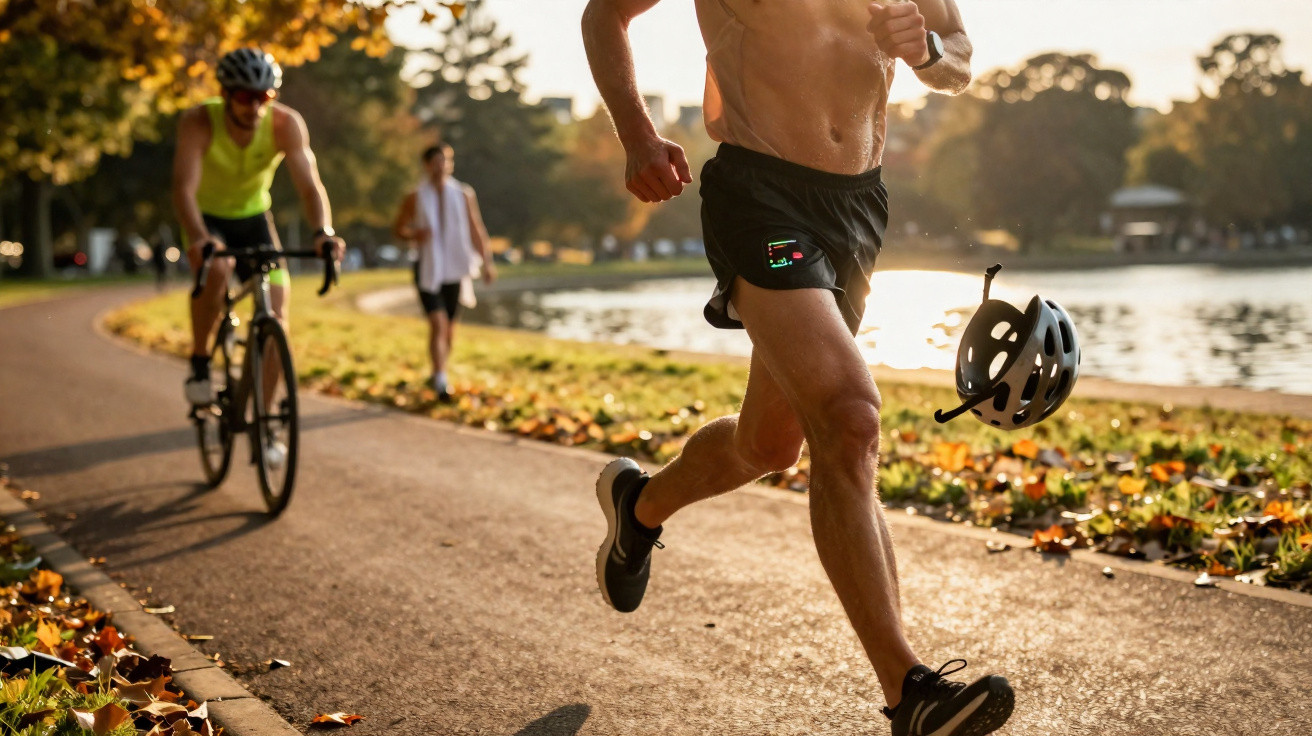
A comparison of 9 endurance sports across more than a million sessions puts running at the very top for intensity. It is hard to find something tougher on the heart - and on the rest of the body.
To answer the perennial question, “which is the toughest endurance sport?”, the health and sport data platform Terra believes it can provide an evidence-based response. Drawing on an analysis of data from over one million training sessions spanning 9 different disciplines, running came out first in the ranking, ahead of indoor cycling (turbo trainer) and cross-country skiing.
Published on 23 April 2026, the findings are presented as a chart showing each sport’s “cardiac signature”. The wave-like shapes represent the distribution of heart rate (HR) - in other words, the average time spent in each zone per session. Compared with the other endurance sports, running’s wave sits furthest to the right, indicating more time at higher HR levels.
The Terra study also plotted a median for each sport using dotted lines, making comparisons between disciplines more precise. According to the chart, running pushes the body to a median HR 9 beats per minute (BPM) higher than a turbo trainer session, and 14 BPM higher than cross-country skiing. The suggested reason is that running is not a weight-supported sport, and there is no glide.
Across the 9 sports, Terra groups the disciplines into three categories: high-intensity (running, turbo trainer and cross-country skiing), moderate (outdoor cycling, open-water swimming, ski touring) and low (walking, alpine skiing and hiking). Notably, the turbo trainer is placed above outdoor cycling because it lacks built-in recovery phases common outside - such as freewheeling downhill - and because riders may have to slow down for traffic.
Limits highlighted by Terra in its endurance sport data
Terra also acknowledged that the study has limitations: “We do not have any demographic information (age, sex, fitness level), which prevents us from separating these effects from those linked to the choice of sport. We also do not know the training objective (easy run or tempo session), which means our data mix structured training and free activity.”
Another constraint relates to the measurement device. The data here largely come from wrist-worn heart-rate sensors (sports watches) rather than advanced chest straps. As a result, accuracy may vary by sport - particularly swimming or skiing - due to arm movement and the surrounding environment.
Different intensity ratios, with a special case: walking
To complement its initial comparison, Terra also set out to highlight an intensity “ratio” for each sport. The idea is that average HR on its own can be misleading, because runners are often healthier on average, rather than the sport simply being more physically demanding. To do this, the platform cross-referenced the data by looking at average HR relative to the maximum HR recorded per session.
Running again sits at the top, because the per-session maximum HR recorded averages 168 BPM, the highest value captured by Terra once more. Versus the other sports, running stands well clear. Outdoor cycling separates itself from indoor cycling, with a much higher average maximum HR: 160 BPM compared with under 145 BPM for turbo trainer sessions.
Walking ranks third among activities with the highest intensity ratio, but this is mainly because there is not a wide swing in effort intensity: whether on flat ground or rolling terrain, the difference remains relatively small compared with other sports. It naturally sits close to hiking. Downhill skiing is not far behind, though for different reasons. In that case, the sport is stop-start, where intense descents contrast with lift rides and queueing in the cold, during which the body’s HR can drop quite low.
93% of runner-cyclists train harder when they run
Finally, Terra also compared intensity within the same individuals across disciplines. Rather than contrasting runners’ fitness with that of cyclists, skiers or hikers, the platform focused on 2,808 participants who had “recorded at least five sessions in at least two disciplines”. To make cross-sport comparisons possible, the study used the following method:
“For each person, we used their maximum recorded heart rate as their personal maximum heart rate, then expressed the average heart rate of each session as a percentage of that maximum value,” Terra explains.
Shown in a new chart, the results indicate that the same people who run at a median intensity of 78% of their personal maximum HR cycle outdoors at only 67% and walk at 52%. The analysis also shows that among 1,480 users who do both running and outdoor cycling, 93% display a higher relative intensity when running.



Comments
No comments yet. Be the first to comment!
Leave a Comment