
A woman studies herself in the mirror. She tilts her head a touch, squints, and tucks her hair back. In the phone she’s holding is a photo from ten years ago: thick, glossy lengths that looked effortlessly full. Now, in her mid-to-late forties, the ends no longer sit the way she wants. The tips look tired, her ponytail droops, and somewhere in the middle she thinks, quietly: “Have I got older - or has my hair?”
Most of us recognise the moment. It happens in the bathroom, wedged between toothpaste, hairspray and a packed schedule. A few grey strands insist on showing up, while the rest takes forever to blow-dry. Then, in a café, you notice a woman at the next table - around fifty - wearing a razor-sharp long bob that makes her face look bright and alive. The question shifts instantly. Not “Am I ageing?”, but “What if my haircut simply looked more modern?”
Why a long bob can do more than endlessly long hair
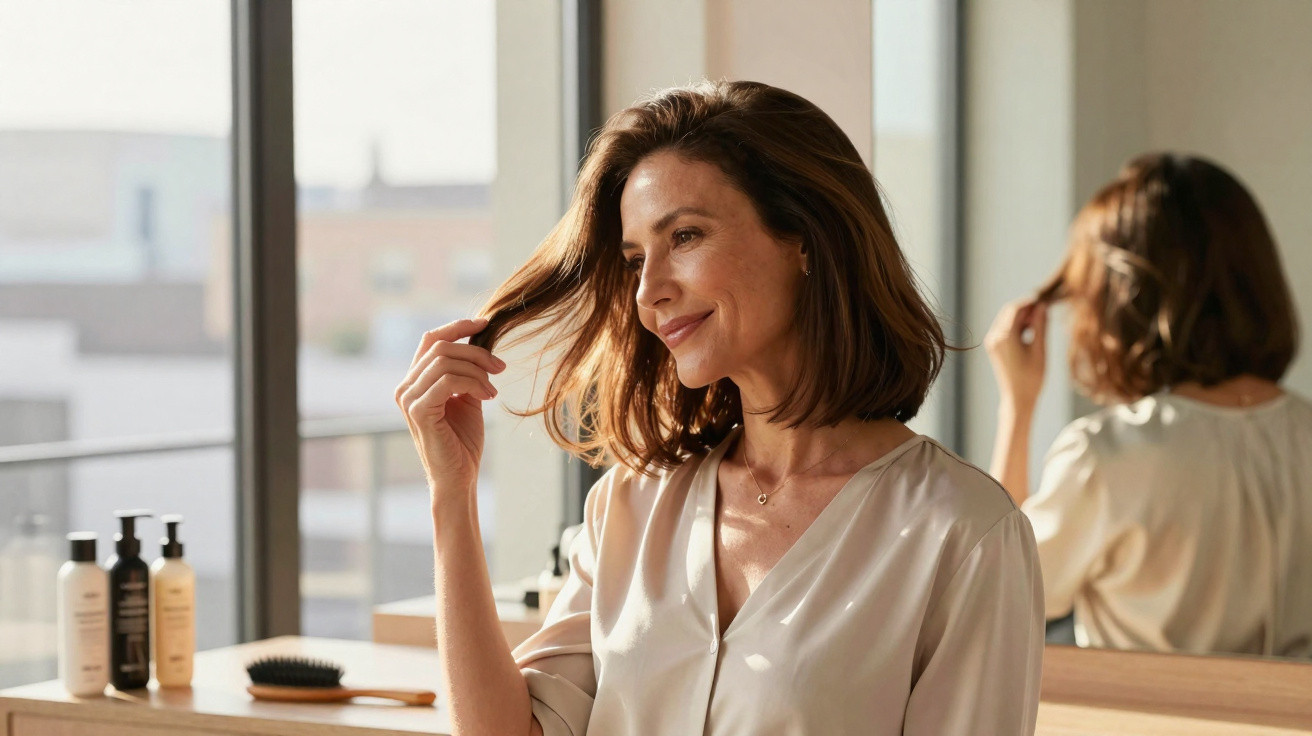
If you really watch women around fifty, the biggest difference is rarely how much hair they have - it’s the shape. A long bob usually finishes somewhere between the collarbone and just below the chin. That length frames the face without swallowing it. Very long hair, by contrast, often drags the whole look down, spotlighting tiredness where there used to be lightness.
A long bob gives the face its moment again. The neck looks clearer, the shoulders seem more lifted, and the outline of the whole look becomes more defined. Instead of noticing “lots of hair”, you notice a person with structure. And that’s exactly why so many women at this age come across as chicer, more present, more modern.
There’s also a simple practical reason. As we get older, hair commonly becomes finer, drier and more fragile. Long lengths need density to fall with that glamorous weight. When the texture shifts, many long styles lose bounce; ends go see-through, roots sit flat, and the overall impression turns a bit weary. A long bob removes the parts that look tired and keeps what still looks strong.
On top of that, facial proportions subtly change over the years. A well-placed long bob can rebalance everything. It puts length where it elongates - often around the collarbone - rather than where it weighs down. A face that can look as though it’s “dropping” suddenly appears slightly lifted. And let’s be honest: hardly anyone has time every day for a perfect round-brush blow-dry just to control a long mane. A smart cut reduces effort - and adds style.
In a salon in Frankfurt, a hairdresser told me about her favourite “before and after” moments. One regular client, 52, had stuck to the same habit for years: long hair, always twisted into a bun, “because it’s practical”. The ends were breaking, the lengths looked dull, and the sheer weight of it pulled her face down. When she finally agreed to a long bob, something happened in the mirror that felt almost audible: her face opened up.
The hairdresser laughed as she replayed it: “She stood up, stepped back and just said: ‘Blimey, I can see myself again.’” At the same time, she looked younger without looking girlish. Her cheekbones showed, her neck looked longer. For years, the long hair had behaved like a curtain. The long bob worked more like a frame. Sometimes a cut changes not only a look, but your whole posture.
How the perfect long bob works at fifty
The magic starts with one decision: where, exactly, should it finish? For women around fifty, a long bob looks strongest when the length is intentional - not vaguely shoulder-length, and not simply “a bit shorter”. A reliable guideline is somewhere between the chin and the collarbone, chosen to suit the neck. If your neck is shorter, it usually works better starting just below the chin. If you have a longer neck, you can comfortably take it down towards the collarbone.
Soft layers through the top add movement without stripping out fullness. What matters is a clean underlying line that doesn’t feel too razor-straight, so the result doesn’t turn harsh. A slight angle forward can visually lift the face. Heavy, feathery layers often date quickly. Texture is better created with styling products than with too many stacked cutting levels.
Many women worry that “shorter” automatically means “stricter”. In practice, it’s often the opposite. A long bob can look extremely soft if you don’t blow-dry it poker-straight. Let it air-dry with a light cream, add a few bends with a curling wand, and you’re done. What tends not to work is treating the bob like the old long style - including endless straightening sessions.
The most common mistake is the compromise cut: “just the ends”, again and again, until the hair is neither properly long nor clearly shaped. It rarely reads as stylish; it reads as “not decided yet”. The second mistake is choosing a long bob without considering cowlicks and the natural fall of the hair. Then the back kicks out, the sides sit flat, and the cut gets blamed instead of the planning.
Mistake number three is using too much product. At fifty, hair often reacts more strongly to silicones and heavy oils. When hair looks flat and weighed down, even a great cut disappears. Better options are lightweight sprays, a touch of volumising powder, and restrained conditioning. Your hair needs to be allowed to move. A long bob lives on air between the strands.
A stylist from Munich put it very plainly:
“Women over fifty don’t need a ‘rejuvenating haircut’. They need a haircut that shows their character now - clear, relaxed, with no apologies.”
To make that work in real life, it helps to run through a quick internal checklist before the scissors come out:
- How do I wear my hair 80% of the time - down, half-up, in a ponytail?
- Which feature do I like best on myself: eyes, cheekbones, neck? The cut should place emphasis there.
- How much time will I realistically spend in the morning - five, ten, or twenty minutes?
- How does my hair behave in humidity - does it puff up or fall limp?
- Am I willing to let go of the “forever long hair” to make room for a new, cleaner look?
What changes when your hair matches your posture
A long bob isn’t a miracle switch that erases wrinkles. It changes something subtler: how a face is read in a room. Suddenly you notice eyes, expression and laughter, instead of mainly noticing hair. Many women describe an almost physical difference after a bolder cut: their head feels lighter, their gaze feels freer, and their movements feel more natural.
At the same time, the cut carries a quiet message: “I’m no longer clinging to earlier versions of myself.” Long hair is often linked - unconsciously - with youth. Having the nerve to let it go can feel liberating. Not because short hair is a requirement, but because chosen clarity tends to look more attractive than holding on out of fear. You see it in the way someone walks into a room, not just in a selfie.
That may be the real reason a long bob so often looks chicer on women around fifty than very long hair: it suits the life they’re actually living. No constant war with split ends, no hours at the mirror, no attempt to compete with being twenty. Instead, a cut that can handle movement, appointments, unexpected evenings and tired mornings - and still looks as though it was meant to be that way.
In the end, it isn’t really about short or long. It’s about the feeling when you look in the mirror and think: “Yes. That’s me - now.”
| Key point | Detail | Value for the reader |
|---|---|---|
| Long bob frames rather than weighs down | Length between the chin and collarbone highlights face and neck | Readers understand why a clear line can make them look fresher |
| Hair texture after fifty | Finer, drier hair benefits from less length | Makes it easier to decide to cut off tired ends |
| A realistic, everyday cut | A long bob needs little styling when planned properly | Brings more calm to the morning styling routine |
FAQ:
- Will a long bob make my face look shorter? Only if it finishes too high. A length just below the chin or at the collarbone generally elongates and looks balanced.
- Can I still wear a ponytail with a long bob? Yes - a small nape ponytail or a half-up ponytail usually works. It simply looks more intentional and less like a “quick fix” than the forever messy bun.
- How often should I have a long bob trimmed? Every 6 to 10 weeks is usually enough, depending on how fast your hair grows and how sharp you want the edge. That keeps the shape clean without living in the salon.
- Does a long bob work with natural waves? Very well, as long as the cut is designed for your wave pattern. Light layering and the right care keep the movement lively rather than frizzy.
- Will a long bob genuinely make me look younger? First and foremost it can make you look more awake and present. That often reads as younger - mainly because your face and expression get more space than your hair length.





Comments
No comments yet. Be the first to comment!
Leave a Comment