

Plenty of people seem to choose a hairstyle on impulse: practical for the office, polished for Instagram, and quick to do in the morning. Yet, according to energy experts and hairstylists, certain cuts can communicate far more than a sense of fashion. Five common “hair zones” are particularly telling - and they can reflect, surprisingly clearly, how you handle closeness, control, vulnerability and self-confidence.
Why hair is more than just styling
Across many cultures, hair has long been associated with strength, identity and freedom. In the Bible, Samson loses his power when his hair is cut; in various religions, cutting the hair can signal a fresh start or an act of renunciation. That symbolism still lingers today, often beneath conscious awareness.
"The way we wear our hair can be read like a map of our inner states - not as a fixed verdict, but as a snapshot in time."
Experienced hairdressers often notice patterns: clients may go dramatically shorter after a break-up, reach for fringes and extra top layers during turbulent periods, or suddenly allow their natural texture to take the lead when life feels steady again. The five hairstyle patterns below show up especially often.
1. Exposed forehead: the urge to live clearly and without excuses
Choosing to show the forehead on purpose - for instance with tightly pulled-back hair, a sleek bun, or strands blow-dried away from the face - tends to read as a strong statement. The forehead is often seen as the “shop window” of personality: expressions, lines, and the play of thought are all on display.
People who keep the forehead clear often come across as having:
- high standards for clarity and honesty
- a willingness to take responsibility
- a desire to be seen as capable and in control
Psychologically, this look is frequently linked with forward-driving energy. Challenges are tackled head-on, and uncomfortable conversations are more likely to be faced than avoided. In that sense, the idea of “I stand by who I am” becomes visible.
There can be a flip side, though. For some, the open, pulled-back look functions like armour. On the outside they appear decisive; on the inside they may feel pressured to perform at all times. If that feels familiar, it can be worth asking: am I serving my life - or mainly my image?
2. Precisely drawn middle parting: the quiet search for inner balance
A straight parting down the centre suggests calm, symmetry and order. It divides the face like an axis and often mirrors an internal wish to balance opposites: emotion and reason, closeness and distance, fitting in and standing apart.
"A middle parting can look like a visible line that signals: ‘I’m trying to balance myself internally.’"
Those who opt for this style commonly aim for:
- inner fairness - towards themselves and towards others
- keeping emotional swings in check
- clear structure in daily life and in relationships
It becomes particularly interesting when the parting appears central but actually sits slightly to the left or right. Some energy experts interpret that like this:
| Position of the parting | Possible tendency |
|---|---|
| slightly shifted to the left | feelings are more likely to be hidden; softer sides feel risky |
| slightly shifted to the right | assertiveness is held back; speaking plainly feels difficult |
This is not a definitive judgement - more a prompt: where might I be off-balance right now? Many people report that, during periods of overwhelm, they suddenly start wearing a different parting without consciously deciding to.
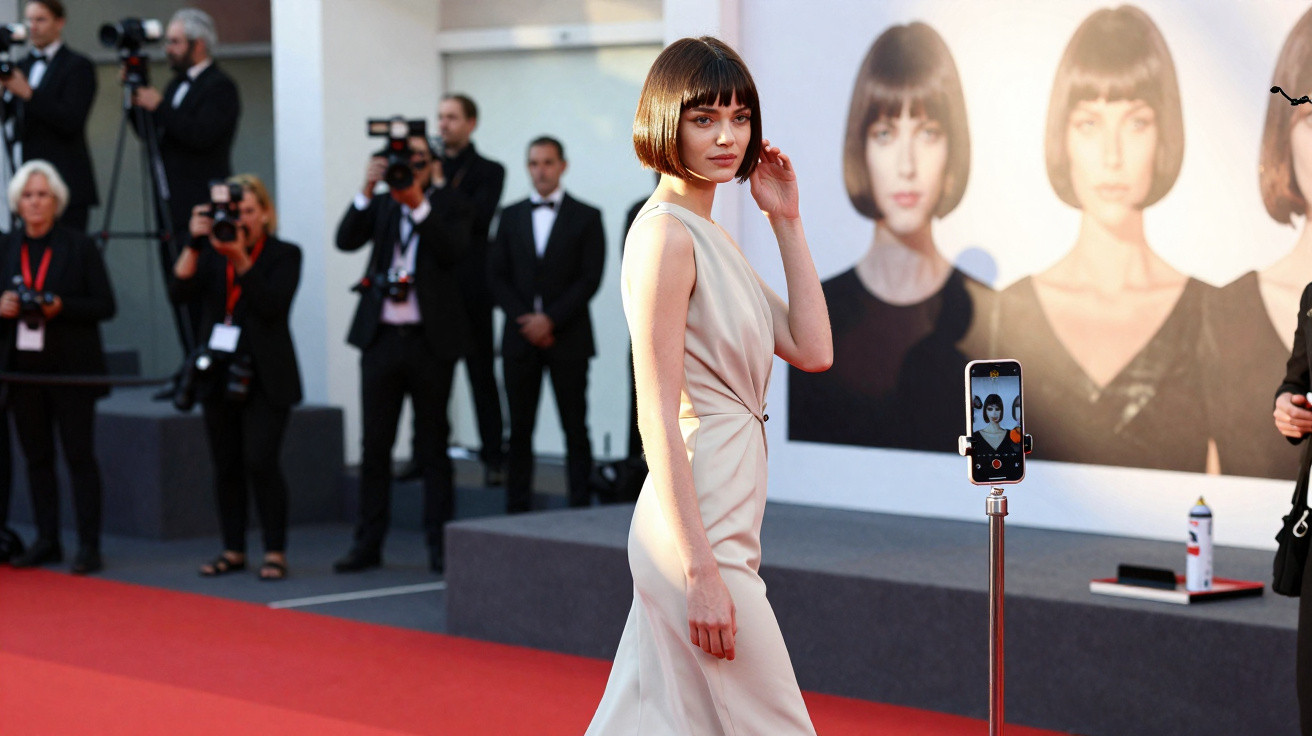
3. Fringe: the gentle shield from the outside world
Whether it is a classic fringe, curtain bangs, or a version that drops partly over the eyes, the effect is similar: part of the face sits behind a small curtain. It protects, and it filters.
Common inner themes among people who choose a fringe include:
- sensitivity to criticism and to being watched
- a strong preference for controlling how much they reveal
- a tendency not to show feelings immediately
A thick, heavy fringe can hint at a deep need to retreat. The person may want to be present, but not fully “read”. A lighter, side-thinned fringe often feels more like a transition: protection, yes - but with cautious opening.
"A fringe can work like a dimmable spotlight: the person decides how brightly their inner world shines outward."
What is striking is how quickly the impression can change: just a few millimetres shorter and the face can look more open, alert and direct. It is not uncommon for that kind of cut to coincide with life stages in which someone dares to show more of themselves - for example during a job change or after a toxic relationship.
4. Exposed nape: the desire to show the real self
In body awareness, the nape is considered a sensitive area. Many people feel ticklish there or hold tension in it. Symbolically, it represents the part of us that seems unprotected when we turn away and have to trust.
When someone deliberately leaves the nape uncovered - with a pixie cut, an undercut, or a closely shaved back of the head - it often reads as a bold message: “I’ve got nothing to hide.”
What frequently sits underneath is:
- a drive for authenticity, even if it creates vulnerability
- a need to shed outdated roles
- an appetite for physical and emotional lightness
After major life events - such as burn-out or a separation - some people choose to go noticeably shorter at the nape. It can feel like a visible break with the past. The sensation is: “I’m letting go of baggage - even at the back of my head.”
At the same time, an open nape can suggest trust in one’s environment. Someone who exposes that area is not constantly expecting attacks from behind, whether literal or symbolic. In toxic settings, therapists often observe the opposite pattern: longer, more protective back sections, and updos reserved for places that feel safe.
5. Exposed temples: how open you are to the outside world
The temples sit at the sides of the head - where external stimuli arrive: voices, glances, noise. In many energetic approaches, they are seen as areas linked to contact and exchange.
Visible temples - for instance with closely cut sides, hair tucked back, or heavily thinned side sections - can indicate:
- readiness to take in new impressions
- curiosity about other people and perspectives
- a wish for mental flexibility
"Open temples often send the message: ‘I’m approachable, I can be touched - in a positive sense.’"
People who prefer to cover the sides with hair sometimes signal the reverse: a tendency towards caution, and perhaps a fear of overwhelm. Longer side pieces can behave like small curtains, giving someone time to sort their thoughts before stepping forward.
This is especially noticeable with introverted people: around trusted friends, hair is pushed behind the ears; in large groups, it tends to fall back into the face without thinking. In that way, hair can act almost like a physical stop sign: “That’s enough closeness for now.”
How to use this knowledge in a helpful way
None of these interpretations are diagnoses. No one should decide there is a “problem” because someone wears a middle parting, or treat a fringe as evidence of a “deficit”. Hairstyles are flexible symbols - they shift as life shifts.
It becomes meaningful when you treat your current hair choice as an invitation to self-reflection. Questions that can help include:
- Do I genuinely feel comfortable with my hairstyle, or am I playing a part?
- When was the last time I changed my cut because I truly wanted to?
- Which life phases do I associate with my earlier hairstyles?
- Is there a style that scares me even though I feel drawn to it?
If you like, you can turn your next hair appointment into a small experiment: move the parting slightly, lift the fringe, or ask for the sides to be cut a little freer. Even minor adjustments often stir up new feelings. Some people say they anticipate different reactions from those around them and, as a result, automatically behave differently - more confident, more open, or calmer.
When psychological support may be helpful
If you notice you are constantly making drastic hairstyle changes yet never feel more satisfied afterwards, there may be something deeper at play than simple fun with your look. Frequent type changes can be a sign that you are searching internally but not reaching the real issue.
In that situation, talking with professional counsellors or therapists can be worthwhile. The hairstyle does not become “the problem”; instead it becomes the starting point: what did I want to express with this cut? What was I trying to protect with this fringe? Why did I suddenly need an exposed nape?
Hair grows back. That fact removes some of the weight - and at the same time opens up possibilities. Every trip to the hairdresser can feel like a small restart. Used consciously, a styling routine can become a quiet ritual of self-clarity - no mysticism required, just an attentive eye on your own inner state.





Comments
No comments yet. Be the first to comment!
Leave a Comment