
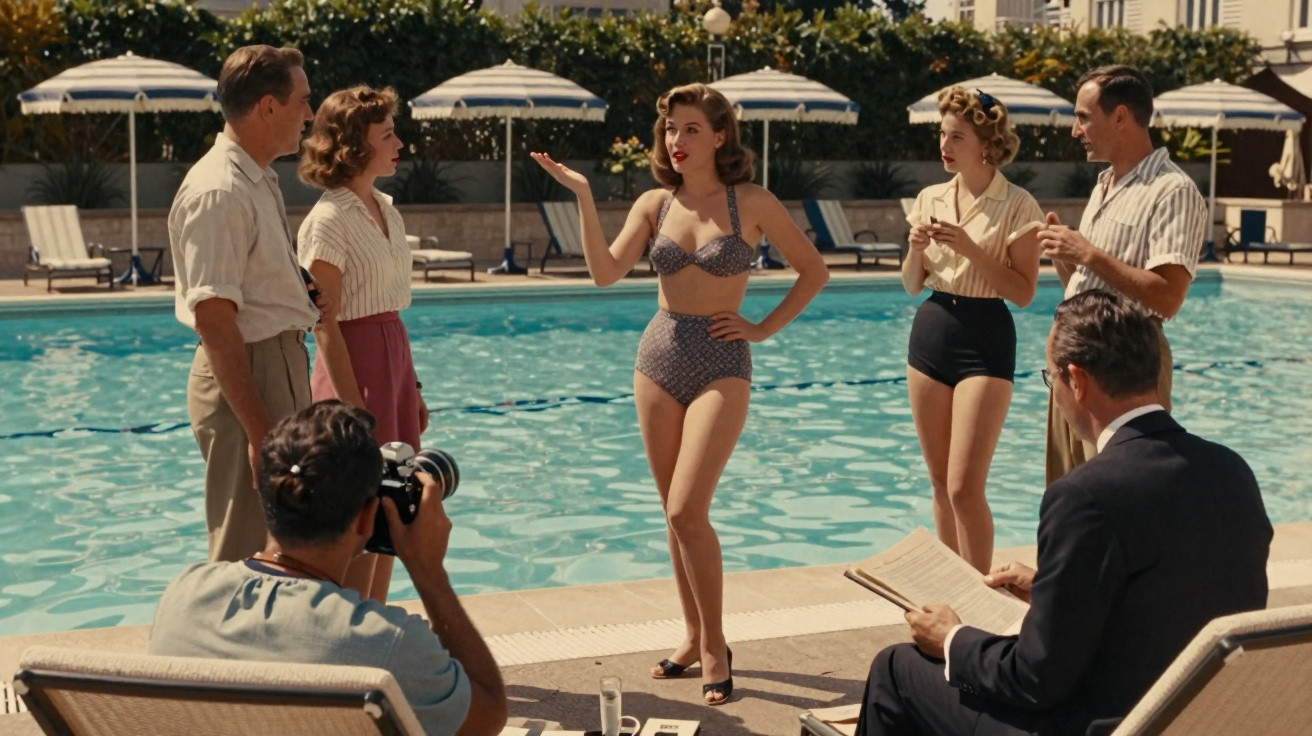
Micheline Bernardini, a dancer at the Casino de Paris, agreed to do what no model would: walk beside a swimming pool wearing two small pieces of fabric that covered only her most intimate areas. In doing so, she helped open the door to a future in which the female body could be seen with far less shame.
Paris, 5 July 1946: a two-piece that jolted the world
On 5 July 1946 in Paris, by an elegant pool in the French capital, a 19-year-old with long, flowing hair and a slim figure faced the photographers with a calm smile. She was defying convention and public modesty, presenting something that startled the world: a bikini-two tiny panels of cloth that, at the time, covered only the essentials.
Today, the term barely needs explaining. Back then, it was entirely unfamiliar. To understand the moment, you have to place it in context. The Second World War had ended less than a year earlier. Europe was still recovering, rationing shaped everyday life, and attitudes to morality and behaviour remained tightly bound to an intensely conservative social code.
Even so, some people were already imagining what might come next. One of them was Louis Réard, an engineer and fashion designer convinced that the future would involve more skin on show. He created the stripped-back swimsuit, fully aware it was likely to shock.
To underline the impact he expected it to have, he named it the bikini-a reference to Bikini Atoll in the Pacific, where the United States was conducting nuclear tests. Réard’s comparison was plain enough: he believed his invention would cause a media reaction comparable to an atomic bomb (Hiroshima and Nagasaki had been bombed only months earlier).
Micheline Bernardini at the Piscine Molitor
The comparison was, to put it mildly, unfortunate. But on the question of impact, Réard was absolutely right-and the backlash began even before the public unveiling.
In 1946, wearing two pieces that small was so far ahead of prevailing taste that Réard ran into an immediate problem: he could not find a single fashion model willing to put on his design. He therefore came up with a practical solution-one that takes us back to the young woman who became the sensation at the Piscine Molitor.
Her name was Micheline Bernardini. Born in Colmar near the German border, she worked as a dancer at the Casino de Paris and often undressed as part of her performances. For that reason, appearing by a pool in a bikini did not strike her as an extraordinary ordeal.
For much of the rest of the world, it was another matter entirely. The presentation staged by Réard and Bernardini caused a stir on such a scale that it travelled worldwide, triggering huge media buzz and setting thousands of male hearts racing for the "Mrs Bikini".
The numbers tell their own story: within a matter of weeks, Bernardini received close to 50,000 fan letters from admirers captivated by the image of the French “mermaid” strolling along the poolside wearing two scant pieces of fabric. Celebrated by many and desired by countless others, she was also sharply attacked-invoked as proof, by critics, that hyper-conservative morality still had plenty of force.
From scandal to symbol: how the bikini became commonplace
Despite the commotion, her celebrity did not last. Bernardini moved to Australia and slipped out of the media spotlight for decades; the only consistent detail to emerge was that she continued working as a dancer.
She returned to public view 40 years later, in 1986. By then, she was almost 60 and agreed to be photographed by Peter Turnley, the acclaimed French-American photojournalist who has photographed some of the most significant figures in modern history-from Nelson Mandela to Mikhail Gorbachev, and from Diana, Princess of Wales to Barack Obama. In Bernardini’s case, Turnley photographed her holding the famous image that had travelled the world four decades earlier.
As for the bikini itself, there is no question that it eventually established itself and became ordinary, turning into a symbol of freedom and women’s emancipation. But that shift took decades and would not have played out without the crucial help of well-known actresses such as Brigitte Bardot and the Bond girl Ursula Andress.
After accepting Turnley’s invitation, Bernardini once again vanished from public view. What is known is limited: she is still alive, she is now 98, and she permanently changed the paradigm of swimwear-even though, when she agreed to that poolside walk in minimal attire, she had no revolutionary ambition at all. As she later said, she simply thought the bikini was "beautiful".
| Field | Details |
|---|---|
| Role | Former dancer |
| Born | 01/12/1927 (98 years) |
| Nationality | French (Colmar) |






Comments
No comments yet. Be the first to comment!
Leave a Comment