
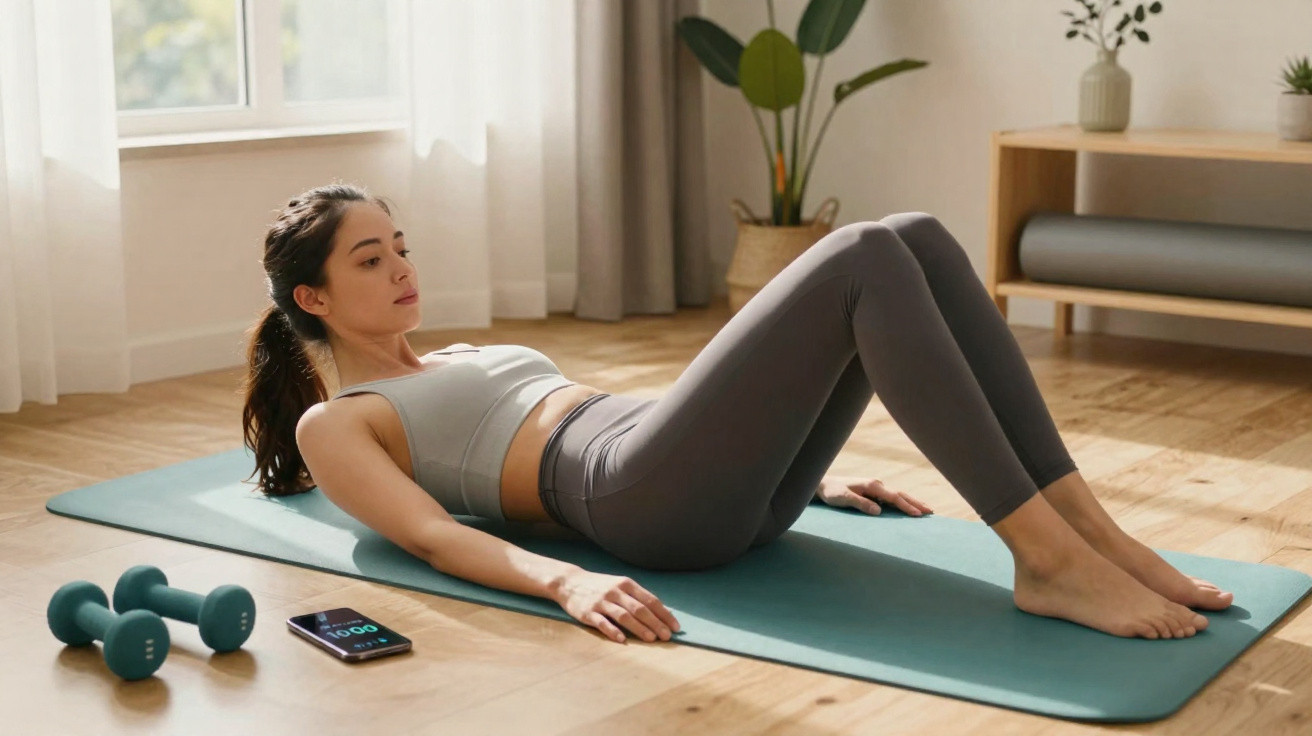
This short training plan is designed to do exactly that.
Many people diligently do sit-ups and then wonder why the lower stomach barely changes. The area below the belly button is considered especially stubborn – here, precise, controlled movements tend to work better than rushed repetitions. The following 10-minute at-home workout is inspired by Pilates and targets exactly that area.
How the 10-minute lower abs workout is structured
The plan includes 10 exercises performed one after another using an interval format. Each exercise lasts 45 seconds, followed by 15 seconds of rest. The pace is intentionally steady, with the focus on technique and core tension.
The key to a toned lower stomach is not speed, but continuous tension and proper control of the movements.
If you're a beginner or need longer recovery, you can start by shortening the work phase to around 30 seconds and extending the rest periods to roughly 30 seconds. Over time, the intervals can be adjusted to increase the challenge for the muscles.
The 10 exercises at a glance
1. Lowering bent legs while lying on your back
Lie on your back with your feet together and your knees pointing slightly outwards. Keep your lower back firmly pressed into the mat. Slowly lower your bent legs towards the floor, then bring them back up with control. Your abs stay engaged the entire time, while your upper body remains still.
2. Extend the legs above the mat and lift the hips
Again, lie on your back. Stretch your legs out one after the other just above the mat, lifting the hips slightly in between. Avoid using momentum: the movement should come from your abdominal muscles, not from jerking the pelvis. Keep breathing steadily.
3. Lower and extend one leg at a time
Lie on your back with your abs braced and your lower back pressing into the mat. One leg stays bent while the other slowly extends forwards and lowers until it hovers just above the floor. Then bring it back in and switch sides. The upper body stays relaxed, while the effort comes from your centre.
4. Upper-body pulsing in a seated position
Sit upright with your knees bent and your feet planted on the floor. Lean your upper body slightly back, keep your abs tight and your shoulders lowered. From there, pulse the upper body very slightly forwards and backwards without sitting fully upright. The movement is small, but demanding – your abdominal muscles work continuously to hold the position.
5. Lean the upper body back and open the legs
From the seated position with bent legs, lean your upper body back while extending your legs forwards into a slight straddle. Ideally, your heels rest only lightly on the floor or hover just above it. Then return with control to the starting position with bent knees.
6. Large vertical scissor kicks on the forearms
Lie on your back and support your upper body on your forearms. Keep your back long and straight, with the chest slightly open. Move your legs in a large vertical scissor motion, alternating them without letting the heels touch down. Let the lower back tilt slightly downwards, avoiding any arching.
7. Legs at a 45-degree angle with lateral opening
From the same forearm-supported position, extend both legs forwards at roughly a 45-degree angle. Keep the upper body stable. Now open the thighs out to the sides and bring them back together. The movement comes from the hips, while the torso stays almost completely still.
8. Alternating leg extensions just above the floor
Return to a flat lying position, with your head lifted and your gaze directed upwards or slightly forwards. Extend the legs alternately just above the floor. Easier version: keep one leg bent while only the other extends at a time. Harder version: keep both legs straight throughout. In either case, your lower back should stay in contact with the mat.
9. Lift the hips alternately with lowering the legs
Lie on your back with your knees bent. First, lift your hips slightly off the mat, as if pushing your pelvis towards the ceiling. Then lower the bent legs forwards with control. Each part of the movement should be slow and deliberate, with no momentum and no arching in the lower back.
10. Horizontal scissors with simultaneous leg movement
To finish, combine two actions: move the legs in a horizontal scissor motion (crossing side to side) while also lifting and lowering them slightly at the same time. The abs brace throughout and the lower back stays firmly on the floor. It is better to make the movement smaller than to let the back arch.
How to get the most out of just 10 minutes
What matters is not how impressive an exercise looks, but how accurately it is performed. If you move too quickly, the abdominal muscles lose part of the load – and the body then steals momentum from the hips or back, which is exactly what you want to avoid.
- Perform the movements slowly and with control
- Keep your abs engaged throughout
- Use your breathing: pair the hardest phase with the exhale
- Do not hold your breath, even during difficult repetitions
- It is better to reduce the range of motion than to fall into an arched lower back
Perhaps the most important rule: not once during the 10 minutes should your lower back drop into an arch.
Many people do not notice in everyday life how often the lower back slightly lifts away from the floor when lying down. In this workout, the rule is: consciously press the lower back into the mat and tilt the pelvis slightly. This helps you activate the deep core muscles that create a stable midsection.
How often you should do the lower abs workout
For noticeable results, it is usually enough to schedule the plan around three times a week – ideally with at least one rest day in between. Your muscles need that recovery time to adapt and become stronger.
If you have not exercised for a while or find that 45 seconds per exercise is too much at first, shorten the work intervals. Consistency beats overdoing it: two clean sessions per week over several weeks will achieve more than an overly intense start that leaves you so sore you give up.
Why training alone will not give you a flat stomach
Even the best lower abs workout cannot work miracles if a clear layer of fat sits over the muscles. These exercises shape and strengthen, but they burn only a limited number of calories. For visible change, nutrition plays a central role.
A sensible combination:
- 3 sessions per week of the 10-minute lower abs workout
- 2–3 cardio sessions such as brisk walking, jogging, cycling or swimming
- A balanced, protein-rich diet with a moderate calorie deficit
If you also add regular day-to-day movement such as taking the stairs, going for walks or doing short activity breaks at the office, you give your body extra signals to tap into fat stores.
Lower abs, deep muscles and the pelvic floor – how it all connects
Many of these exercises are inspired by Pilates because that style of training specifically targets the deep core muscles. Alongside the rectus abdominis, this includes the obliques, the transverse abdominis and the pelvic floor. Together, they work like an internal corset.
Getting stronger here does more than improve how your stomach looks. A strong core:
- takes pressure off the lumbar spine in daily life
- improves stability when lifting shopping bags or children
- supports better posture when sitting at a desk
- helps performance in sports such as running, tennis or strength training
In particular, consciously maintaining tension and working within a pain-free range improves body awareness. After a few weeks of training, many people notice more clearly when they slip into an arched lower back and when the abs are truly active.
Practical tips for getting started at home
For this plan, you only need a mat or carpet and a bit of space. A quiet room where you are not constantly interrupted is ideal.
A few simple tricks can help you stick with it:
- Schedule a fixed time, for example straight after getting up or after work
- Set a timer on your phone for 45/15-second intervals
- Make a small note of which exercise feels especially difficult – that is often where the greatest potential lies
- Start with no more than two rounds per week, then build up gradually
If you also include a light warm-up, such as a few minutes of easy skipping, star jumps or dynamic stretching, you prepare the body better for the effort and reduce the risk of stiffness.
These 10 minutes give you a compact foundation: your lower stomach will not become flat overnight, but you are giving the muscles exactly the stimulus they need to become firmer and support you more steadily in everyday life.




Comments
No comments yet. Be the first to comment!
Leave a Comment