
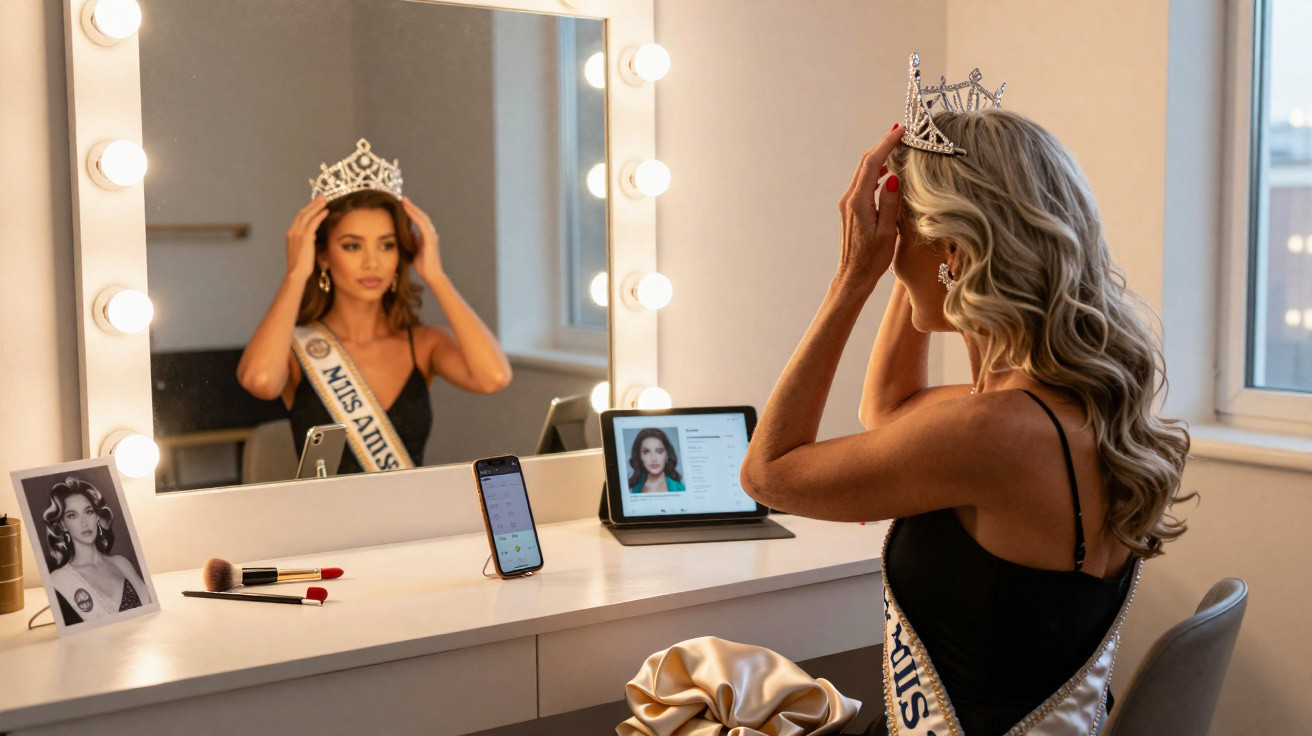
Marking the 75th anniversary of the long-running beauty pageant, one former titleholder is looking back from a very different era. Muguette Fabris, crowned in the early 1960s, traces how the competition has shifted over time - and explains why, in her view, many finalists lose a slice of their own personality once the cameras start rolling.
A Miss from the 1960s watching today’s show
In the early 1960s, Muguette Fabris was among the country’s most recognisable young women. Crowned in a historic theatre, she embodied a kind of Miss image that feels worlds away from Instagram filters and teams of coaches: she was a mathematics teacher at the time and later even gained entry to the elite École Polytechnique.
Even now, she watches the annual gala on television. With a notepad in hand, she makes her own ranking of the candidates. She enjoys the spectacle, she understands how it works - and she can also feel what has changed.
"At the moment of the vote," she says, "some candidates lose part of what makes them distinctive, because they are managed too tightly and recite memorised lines."
That, for Fabris, is the heart of it: the young women come across as impeccably prepared, yet increasingly interchangeable.
Too much coaching, too little personality?
From what she has seen, today’s contestants are accompanied and trained from the very first casting round. Catwalk practice, interview coaching, social media guidance - it is all part of the package. It adds polish on stage, but it also, she feels, strips away some spontaneity.
As the former Miss describes it, this is what tends to happen under the lights:
- Emotions are intense, but heavily controlled.
- Answers sound rehearsed rather than genuine.
- Free-thinking gets lost in the show’s tight running order.
- The competition shapes an ideal that many end up conforming to.
Contestants are expected to appeal to as many people as possible. That is understandable - after all, millions of viewers vote. Yet the same logic can push participants to smooth off their edges, leaving only glossy, very similar façades.
The candidates’ knowledge - a good idea, only half delivered
Fabris does welcome one development: today it is not only appearance and presentation that matter, but also general knowledge. She considers rounds featuring questions on history, art or politics to be worthwhile. For her, though, the standard of the questions still does not go far enough.
"She would like the candidates to answer spontaneously, rather than simply ticking boxes in a multiple-choice test."
In her eyes, a direct back-and-forth would be more engaging - and more honest. Anyone who truly wants to stand in the spotlight, she argues, should be able to express their own thoughts clearly.
Back then: no media professionals; now: made-for-TV performers
The gap between her era and today’s production is hard to overstate. Fabris recalls sets without coaching teams, without hours of briefings, without the pressure of social media. Behind the scenes, it was mainly journalists waiting with questions - and they expected answers with no prior agreement.
The contestants of that period:
- received no interview training,
- had no pre-planned media schedule,
- had to respond on the spot,
- represented themselves rather than a brand.
Their life paths also tended to remain far more grounded. Fabris herself did not put her teaching job on hold; she simply continued with her profession. The crown was one chapter in her life - not a complete reset of her future.
Today, showbusiness and influencer careers are the prize
Watching current contestants, she notices a clear direction of travel: many aim for careers in television, radio or as influencers. The pageant becomes a springboard into a media pathway.
But she also sees a hazard in that. Only a small number manage to stay in the public eye for the long term. Others, after one or two intense years, find themselves back at the start - without a completed qualification and carrying expectations that reality rarely meets.
"Fabris therefore advises all young women to think early about their professional future - regardless of the outcome of a beauty pageant."
She is particularly wary of the pull of social networks. One awkward photograph, one comment that can be misunderstood - and a hard-earned reputation can be damaged in a short space of time.
Between tradition and change: how much can the show absorb?
In recent years, the pageant’s rules have gradually become more open. Age limits, requirements around marital status or body image are debated and then adjusted step by step. Fabris welcomes some of these shifts, while remaining sceptical about others.
She preferred the earlier approach, where certain life circumstances meant exclusion because they reflected a particular view of the winner’s role in public life. From her standpoint, the competition inevitably broadcasts an idea of femininity - and that image shapes generations of viewers.
At the same time, she is clear that every woman should be free to live and love on her own terms. No one, she believes, should have to mould their private life around a television format. For Fabris, education and upbringing are crucial: learning to think independently early on leads to more confident decisions later - whether on a stage or in everyday working life.
How digitalisation and AI could reshape the competition
One subject that occupies the former Miss in particular is the pace of technological change. Video auditions, filters, retouching, scoring algorithms - technology already reaches deep into selection processes. With AI, those effects could intensify.
Possible scenarios discussed within the industry include:
- AI tools that automatically select the “most expressive” photos.
- Software that evaluates performances - from facial expressions to word choice.
- Virtual training programmes for catwalk work, voice and interviews.
- Simulated social media reactions before a show goes live.
These tools can make production more efficient. They also carry the risk of creating an algorithm-driven ideal that real people can scarcely live up to.
What young candidates can learn from this experience
From Muguette Fabris’s perspective, several practical lessons emerge - ones that reach well beyond any beauty pageant:
- Define your own profile: Know your personal strengths, not only your outward appearance.
- Secure your education: Plan your schooling and career path before the TV spotlights come on.
- Build media literacy: Weigh up the opportunities and risks of social media realistically.
- Set boundaries: Do not accept every instruction from management or an agency without question.
It is social media, in particular, that makes the former Miss frown. She rejects those platforms herself, having seen how intense the pressure to perform and self-present can become. Anyone entering the competition, she argues, should at least understand how unforgiving comment sections and likes can be.
It is also striking how she talks about emancipation. For her, real independence does not begin in a flash of photographers’ lights, but in daily life: having your own income, a solid education, and the ability to make decisions without following someone else’s script. The competition may open doors - but it is not a substitute for a durable foundation.
What she feels when she watches the modern show is therefore mixed: fascination with its professional staging, alongside concern for the young women’s individual freedom. The production grows bigger, faster and more digital - but the question, she thinks, is whether there is still enough room left for the candidates’ character.



Comments
No comments yet. Be the first to comment!
Leave a Comment